Written by Lorraine Pan
Edited by the Taiwan Gazette
Photo by Adam Yang
Speaker Bios:
Lin King is a featured guest at the 2025 Toronto International Festival of Authors. Her English translation of Taiwan Travelogue by Yang Shuang-Zi (Graywolf Press) received the 2024 National Book Award for Translated Literature and the 2024 Baifang Schell Book Prize for Outstanding Translated Literature in Chinese.
Matthew M. Mucha is a PhD Candidate in the Centre for Comparative Literature and a sessional lecturer at the University of Toronto, with Collaborative Specializations in Diaspora & Transnational Studies and Women & Gender Studies. He is also co-editor of The Taiwan Gazette, a publication affiliated with the Global Taiwan Studies Initiative at the University of Toronto’s Munk School of Global Affairs and Public Policy.
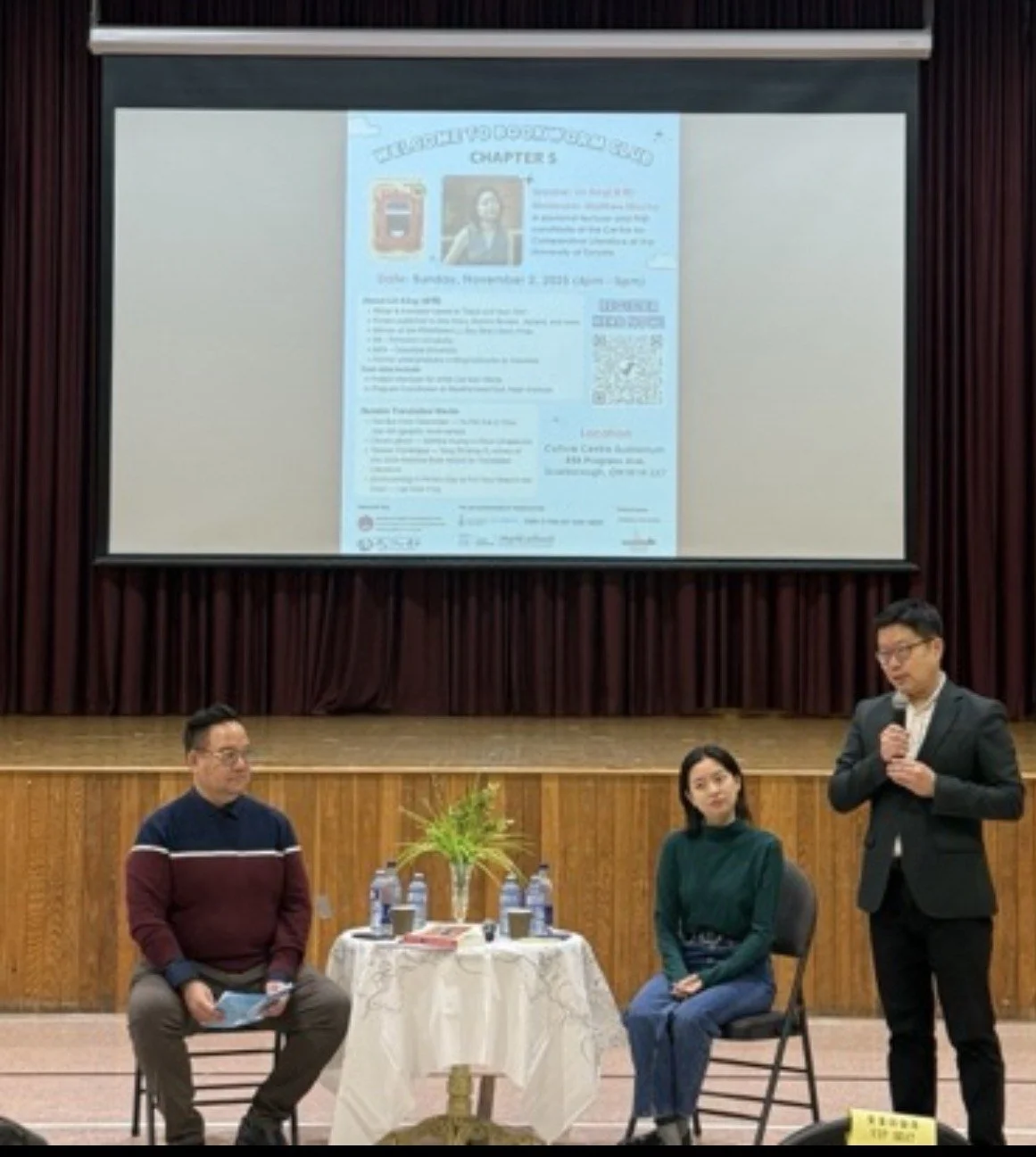
On November 2, a conversation with Lin King, the translator of Taiwan Travelogue, was held at the University of Toronto, in dialogue with Matthew Mucha, a PhD candidate at the Centre for Comparative Literature and a sessional lecturer. The event was supported by the Culture Centre of the Taipei Economic and Cultural Office in Toronto and the Taipei Cultural Center in New York and co-hosted by the Cheng Yu Tung East Asian Library and the Global Taiwan Studies Initiative at the Munk School.
Lin King is an award-winning writer and translator based in Taipei and New York. This year, she was invited to the Toronto International Festival of Authors. At the University of Toronto, she also gave a talk to introduce Taiwan Travelogue, which won the 2024 National Book Award for Translated Literature.
After the welcoming speaking from Hana Kim, the Director of the University of Toronto’s East Asian Library, Lin King introduced the book Taiwan Travelogue. She explained that the work, written by Yang Shuang-zi, is about the history of Taiwan between the 1950s and 1970s. This book is presented as a translation from a fictional Japanese author. In reality, the supposed “translation” is entirely fabricated. Yang imagines the book as a translated work to fill in the gaps of Taiwanese history through creative reconstruction.
King shared that when she met Yang in 2021, she was still a graduate student at Columbia University. After reading the book and finding it fascinating, King decided to start the journey of translating from Chinese to English. In response to Mucha’s question about the Taiwanese diaspora context of the book, King explained that she had to conduct much preparation work with scholars. Many place names, especially those of small towns, had different versions in the period right after Japanese rule, so she had to verify the colonial-era names with Japanese scholars. Regarding the translation of food names, King also noted that some were translated following Chinese Pinyin, some were translated following Japanese conventions. She emphasized that the complexity of translating Taiwanese city names, foods, and cultural references reflects the complexity of Taiwanese culture itself. After a long history of colonization, the Taiwanese and cultural practices have changed a lot, which is why the Taiwanese identity today is so unique.
Mucha also mentioned the queer elements in the book, and King responded by explaining the cultural differences across languages. In English, “queer” is a broad umbrella term that refers to anything outside cisgender and heterosexual romance. However, in Taiwan, the concept is more specific. The book is described as Baihe (百合) novel in Taiwan, and this is a term from the Japanese word yuri. This term is originally used in manga and anime to describe female–female romance, but in Taiwan it has taken on a diversified meaning: it can describe relationships between women who are not necessarily lovers, but may be family, friends, or share other forms of intimacy. It is therefore not a typical homosexual love story. When King introduced the work to audiences in the United States, it was categorized as queer literature, though the book is more of a historical narrative. King explained that Taiwanese culture has its own unique ways of expressing queerness, distinct from Western discourse.
King also shared her experience translating The Boy from Clearwater by Yu Pei-Yun and Zhou Jian-Xin (Levine Querido). The book tells the story of a person imprisoned for organizing a book club during the White Terror period, who later dedicated his life to human rights work. As someone born in the 1990s, entirely after the end of martial law, King mentioned that she hadn’t learned about this history in school but was fortunate to learn it through the process of translating this book.
In the end, King shared her vision for the future of Taiwanese literature, explaining that only about 3% of translated books make it into the English-language publishing market. The only way forward, she said, is through continued hard work to increase the visibility of Taiwanese literature. As Taiwan remains the only place in the Sinophone world with true publishing freedom, she expressed both her determination and hope to bring Taiwanese literary voices to the global stage.