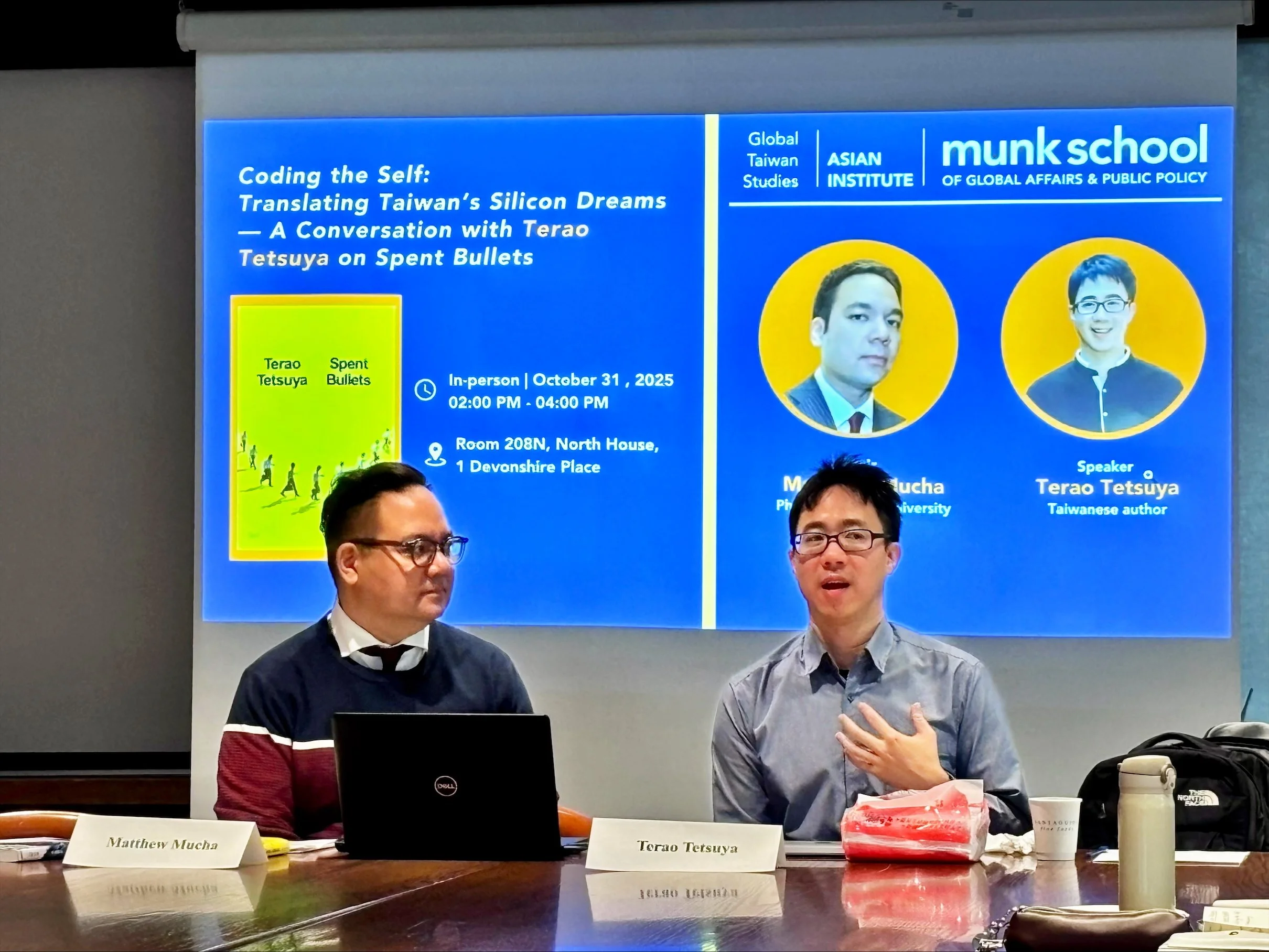
Terao Tetsuya (right) and Matthew Mucha (left) in conversation at the event hosted by Global Taiwan Studies program at the Munk School of Global Affairs and Public Policy.
Speaker Bios:
Terao Tetsuya is a Taiwanese writer from National Taiwan University with degrees in Computer Science Information Engineering. He earned a master’s degree in software engineering from Carnegie Mellon and worked as an engineer at Google before turning to writing full-time. He published debut short story collection Spent Bullets and essay collection Overfitting. Spent Bullets won Taiwan Literature Awards’ Golden Book Award and the New Bud Award.
Matthew M. Mucha is a PhD Candidate in the Centre for Comparative Literature at the University of Toronto, with Collaborative Specializations in Diaspora & Transnational Studies and Women & Gender Studies. He is also co-editor of The Taiwan Gazette, a publication affiliated with the Global Taiwan Studies Initiative at the University of Toronto’s Munk School of Global Affairs and Public Policy. His current research project, entitled “Dictatorial Cultures Across the Luzon Strait: Gendered Memory in the Martial Law Literatures of Taiwan and the Philippines,” undertakes a comparative literary analysis of novels written by women authors about martial law in the Philippines and Taiwan.
On October 31, 2025, Taiwanese writer Terao Tetsuya had a conversation with Matthew M. Mucha to discuss the newly released English translation of his book Spent Bullets. He shared reflections on the hidden costs of coding the self through the technology industry in his characters, along with his own lived experiences as a former IT engineer.
In the beginning, Terao shared his original motivation for writing. He started writing fiction in high school, though he mainly focused on fan works based on manga at that time. Later, he entered National Taiwan University, one of the top universities in Taiwan, to study computer science and information engineering. After earning an additional master’s degree in software engineering, he joined Google. During this period, he kept actively participating in the literary competitions. A turning point that allowed him to become a full-time writer came when he received several awards and got his first book contract.
Mucha then opened the discussion by asking a question related to the character in the first chapter of Spent Bullets: whether Terao considered the pursuit of high positions in society to be a specifically Taiwanese narrative or a transnational phenomenon. Terao responded that he believed the “Taiwanese dream” is different from the “American dream.” In Taiwan, social norms tend to define success in terms of science and productivity. He shared stories that some students even set video games to English mode so that playing would not be considered a waste of time. He also mentioned the existence of special classes designed for those from elite backgrounds. This mindset, he reflected, influenced him for many years. Until an emergency hospitalisation caused by overwork during his final two years in Tokyo, he decided to leave the tech industry and pursue a new career in writing.
Mucha and Terao later discussed the differences between Taiwanese, Japanese, and Western narrative structures and writing styles. Terao also shared an interesting detail about the English edition’s book cover. At first glance, it appears to be a smiling face, but upon closer examination, it is actually men walking endlessly along a road. This visual metaphor reflects the characters’ lives, which are admired by others on the surface, but filled with difficulties inside. He also noted that the English title Spent Bullets carries a sexual implication as a book of queer and BDSM communities, which is different from the original Chinese title.
Terao also shared his experiences and work during the process of translating the book into English. He is close to the translator, Kevin Wang, and often works as the first reader of the English drafts. Through this collaboration, he learned many about translation and the cultural differences between languages. Guided by Mucha’s discussion on world literature through translation, Terao reflected on his goals were letting readers from different language background get entertainment and took it as a potential start to reach more Taiwanese literature in the future. He also expressed his wish for more Taiwanese literary works to be translated and shared with the world.
As a writer who actively follows readers’ feedback, Terao shared his observations about different reader groups. In Taipei, he once received comments from an English-speaking group who read the first two chapters of his book and described the characters as “psychopaths” because they didn’t express their emotions openly. Terao explained that in many East Asian societies, people tend not to show their feelings directly, which might appear as an indifference or inhumanity to Western readers. He also noted the contrasting reactions from Chinese and Taiwanese readers, recalling how moved he felt when a reader told him they were inspired by his work to write their own novel about coding.
In the Q&A session, he was asked if he had ever considered continuing engineering work. He replied that whenever he asked himself whether to do engineering or writing, he always chose the latter. He further explained that in Taiwan, success is often narrowly defined, emphasising academics, achievement, and financial recognition. But he did also mention that this phenomenon is being challenged by the new generations.
With the suggestion to work on a second project, Terao’s writing has become an important mark of Taiwanese culture in the English-speaking world.