Speaker Bios:
Speaker Chris Horton is a journalist who has been based in Taiwan since 2015, covering the country’s foreign relations, domestic politics, economy, society and more. Chris’ writing has appeared in outlets including The New York Times, Nikkei Asia, Bloomberg News, The Atlantic, Financial Times, The Guardian, The Wire China, and ChinaFile. Chris is author of the book Ghost Nation: The Story of Taiwan and its Struggle for Survival, published by Macmillan in July 2025.
Discussant Joseph Wong is a Professor in the Department of Political Science and serves as the Vice President, International, for the University of Toronto. He was the Ralph and Roz Halbert Professor of Innovation at the Munk School of Global Affairs & Public Policy through June 2023.
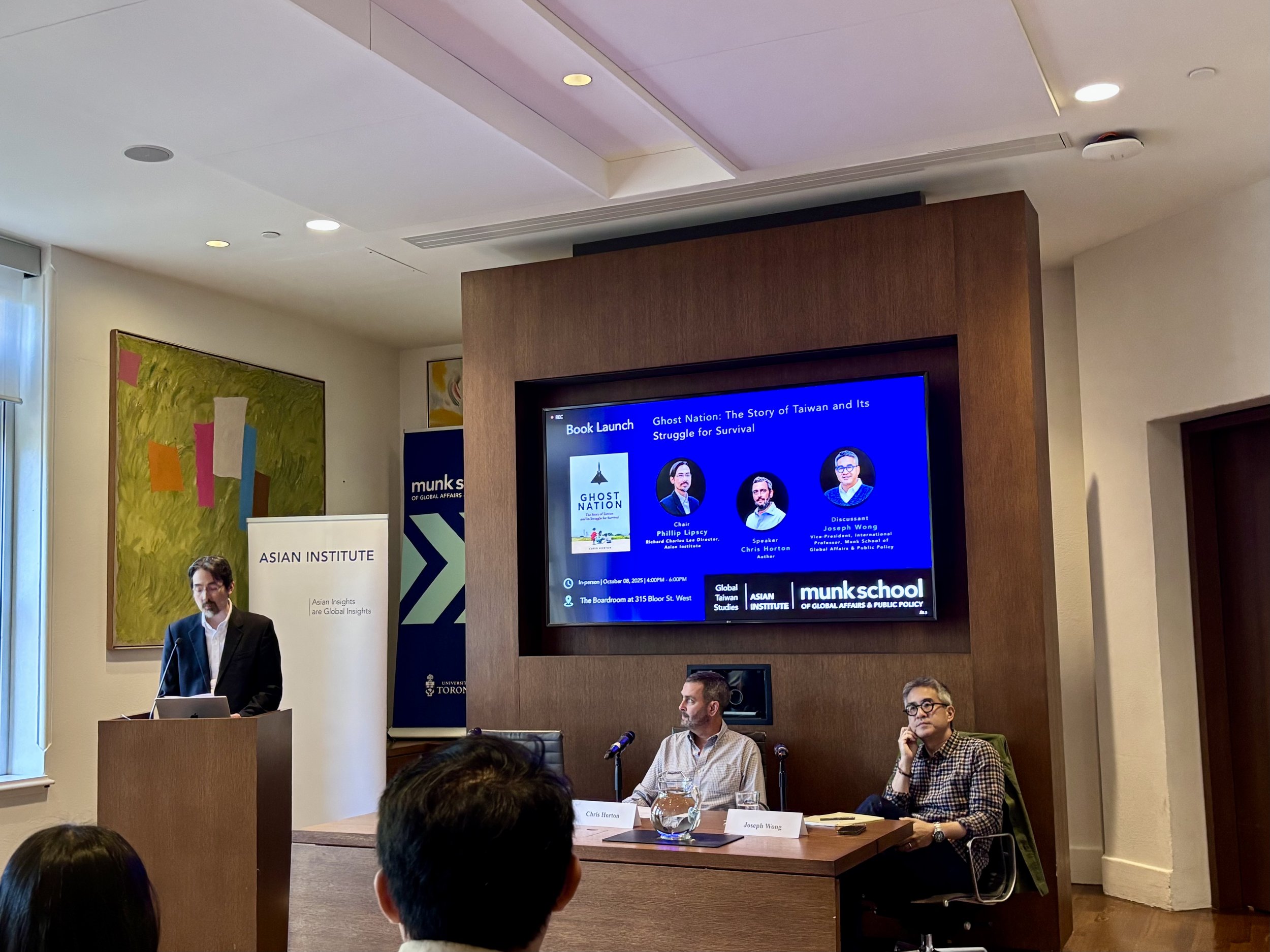
On October 8, 2025, journalist Chris Horton, who has been covering Taiwan’s politics and society for the past ten years, gave a talk on Taiwan’s history and struggles, along with his new book, Ghost Nation: The Story of Taiwan and Its Struggle for Survival. The event was hosted by Phillip Lipscy, Director of the Centre for the Study of Global Japan at the Munk School, and featured Joseph Wong, Professor in the Department of Political Science, as the discussant.
Horton began by discussing Beijing’s claim that Taiwan is part of China, showing how Taiwan’s independent perspective has been hijacked by the Chinese government and its invisibility on the international stage. He then turned to Taiwan’s own history, beginning with its experiences of colonization and resistance. Horton first introduced the period of Dutch and Spanish Formosa from the 1620s to the 1660s, followed by Koxinga (Cheng Cheng-kung)’s Tungning Kingdom and the Qing Dynasty’s rule from the 1680s to the 1890s. Then came the Japanese colonial era from 1895 to 1945, where he highlighted Hieh Wen-ta, the first Taiwanese aviator who took political protest against Japanese rule to new heights in 1923 during this period.
Then, Horton mentioned the Chiang regime from 1945 to 1987, noting that there were only four years in human history when a Chinese government controlled all of Taiwan. Here, he emphasized that the current Chinese government’s use of this period of history to justify its intention to invade Taiwan is unreasonable. Later, he moved to Taiwan’s own political history, starting with “Mr. Democracy” Lee Teng-hui, followed by the first DPP (Democratic Progressive Party) president, Chen Shui-bian, and later using “the KMT (Kuomintang)’s Strikes Back” to describe Ma Ying-jeou’s ruling period. Afterwards, it was Tsai Ing-wen, who was described as “The Tightrope Walker” in Horton’s presentation. During her presidency, Tsai recognized Indigenous peoples in Taiwan, representing Taiwan’s further development. And now, it is Lai Ching-te’s time. Horton noted his efforts to support Taiwan’s survival in today’s increasingly intense geopolitical environment.
After Horton’s presentation, Joseph Wong shared his experiences visiting Taiwan, praising its democracy and liberty for supporting LGBTQ+ rights and maintaining good public health. He noted that Taiwan’s liberation is part of its broader resilience to survive, and connected this to Canada’s resilience, which he suggested could serve as a reference point.
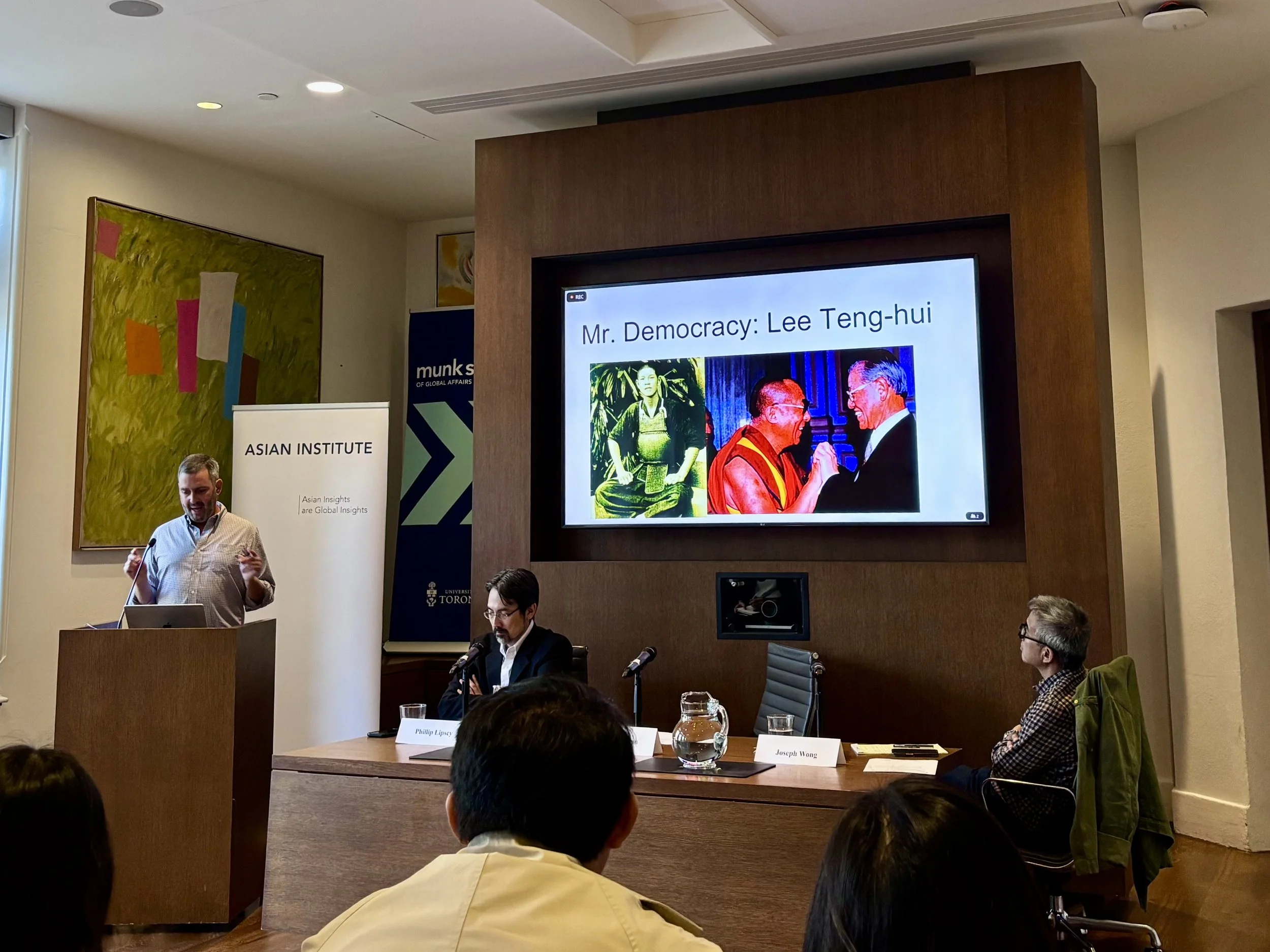
In the Question-and-Answer section, Horton further explained that current Taiwanese public opinion refuses to be ruled by the People’s Republic of China. He also answered one question from the audience about the comparison between Taiwanese and Irish experiences, pointing out the similarities between these two cases and expressing hope for a future conversation on them.
With the book signing activity later, Horton’s Ghost Nation is an important way for readers to further understand Taiwan and its society.