The Taiwanese Public Debates Security: Political Polarization and Deterrence (A Conversation with Professor Alastair Iain Johnston)
November 12, 2025
3:00PM - 5:00PM
Online
Speaker’s Bio:
Alastair Iain Johnston (PhD University of Michigan, 1993) is the Gov. James Albert Noe and Linda Noe Laine Professor of China in World Affairs in the Government Department at Harvard University. He has written on strategic culture, socialization theory, and identity and foreign policy, mostly with application to the study of East Asian international relations and China's international relations. Recently he has been working on how perceptions of identity difference and racialization may drive security dilemmas. Johnston is the author of Cultural Realism: Strategic Culture and Grand Strategy in Chinese History (Princeton 1995) and Social States: China in International Institutions, 1980-2000 (Princeton University Press, 2008), and is co-editor of Engaging China: The Management of an Emerging Power (Routledge 1999), New Directions in the Study of China’s Foreign Policy (Stanford 2006), Crafting Cooperation: Regional Institutions in Comparative Perspective (Cambridge 2007), Measuring Identity: A Guide for Social Scientists (Cambridge 2009), and Perception and Misperception in American and Chinese Views of the Other (Carnegie Endowment for International Peace 2015). He has published in International Security, International Studies Quarterly, International Organization, The Journal of Conflict Resolution, Perspectives on Politics, The Cambridge Review of International Affairs, The China Quarterly, among other journals and edited volumes. From 2007-2024 he was a member of the National Academy of Sciences Committee on International Security and Arms Control.
Victor C. Falkenheim (the Chair of the talk) is Professor Emeritus of Political Science and East Asian Studies at the University of Toronto where he has taught since 1972. Educated at Princeton (B.A) and Columbia (MA & Ph.D) Professor Falkenheim has previously served twice as Chair of the Department of East Asian Studies as well as Director of the Joint Centre for Modern East Asia. His research interests and publications center on local politics and political reform in China. He has lectured widely in China and has worked on a number of CIDA and World Bank projects in China over the past two decades. His current research focuses on issues dealing with migration and urbanization.
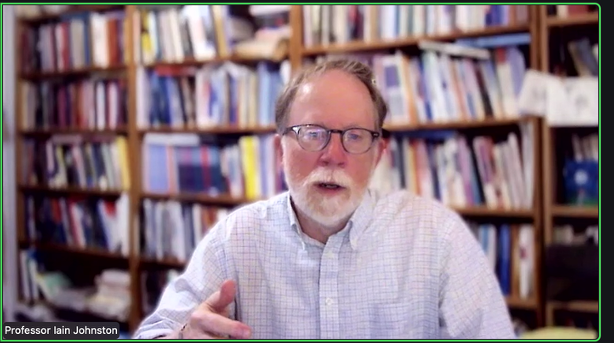
On October 12th, 2025, organized and sponsored by the Global Taiwan Studies Initiative at the Asian Institute, Professor Alastair Ian Johnston of the Government Department of Harvard University gave a talk titled “The Taiwanese Public Debates Security: Political Polarization and Deterrence.”
To begin with, Professor Johnston introduced his recent research project on public opinion in Taiwan and its effects on cross-strait relations. He asks the question, “What are the implications of this polarization (in Taiwanese public opinion) for the deterrence of the PRC’s use of force?” He approaches the question from an international relations perspective, combining Thomas Schelling’s theory of deterrence with Rachel Myrick’s work on polarization in democracies.
Professor Johnson explained that effective deterrence depends on two core elements: credible threats of coercion and credible assurances. In Taiwan’s case, deterrence requires both a strong coercive capacity (reflected in Taiwan’s willingness to fight and the United States’ readiness to intervene) and credible assurances (meaning a low likelihood that Taiwan will pursue de jure independence). Democracies, he noted, traditionally have advantages in maintaining stability, credibility, and reliability in foreign policy. However, rising political polarization undermines these strengths by increasing policy instability, weakening the credibility of commitments, and reducing reliability as allies or partners.
Drawing on survey data from the 2025 Taiwan National Security survey (TNSS), Johnson highlighted deep partisan divisions among Taiwan’s major political groups: the Kuomintang (KMT), Democratic Progressive Party (DPP), Taiwan People’s Party (TPP), and independents. The attitude of supporters of each partisan group towards a wide range of issues significantly varies. These issues include, but are not limited to, strengthening the military force, the willingness to fight, perception of U.S. intervention, the attitude towards independence if it would trigger war, and the likelihood of China declaring war if Taiwan declare independence.
Professor Johnson argued that polarization weakens both pillars of deterrence. KMT positions reduce the credibility of Taiwan’s coercive capacity, signaling a limited willingness to fight, while DPP positions weaken assurances by keeping the possibility of independence open. This dual effect creates ambiguity about the success of deterrence overall. Most interestingly, he noted that the U.S.’s “strategic clarity”, a clear commitment to Taiwan’s defense, has mixed effects: it increases KMT supporters’ willingness to resist but also strengthens DPP supporters’ enthusiasm for independence.
According to Johnson, analysts in the PRC are well aware of these internal divisions. They closely monitor Taiwan’s shifting public opinion and the long-term trend toward a stronger Taiwanese identity. At the same time, the PRC continues to seek assurances from the U.S. that Taiwan will not move toward formal independence, which is an indication that Chinese strategists understand the assurance component in deterrence theory.
In the Q&A session, the audience of the talk askes a wide range of questions concerning the future of cross-strait relations and how the elite perception of Taiwan in China and the U.S. may affect how the relations evolve. Professor Johnson noted that mutual communications between Taiwan and China are unlikely to be productive as the two sides have very different interpretations of the status quos and that the conflict of core interest remains. It is yet to see whether the China side will resort to force, and there remains a lot of room for interpretation about the true intention of Xi’s government. When it comes to U.S. foreign policy, Professor Johnson thinks that the Cross-Strait relation is not the U.S. government’s top concern, but they would be unwilling to lose in the political conflict. Professor Johnson’s presentation concluded by calling for further research on how Taiwan’s internal polarization influences U.S. public and elite perceptions of Taiwan as a credible and reliable security partner.