
Speaker Bio:
Dr. Kennedy Chi-pan Wong is an Assistant Professor of Sociology at The King’s University. His research focuses on diaspora organizing processes and the political polarizations that emerge in alliance formations. His current book project, Multipolar Politics, based on five years of global ethnography, examines how political fault lines and transnational repression shape the formation of alliances in the context of global migration and diaspora organizing. His work has appeared in American Behavioral Scientist and the Journal of International Migration and Integration. He has received several graduate student paper awards, including an Honorable Mention from the ASA Human Rights Section.
Discussant:
Bernice Hoi Chung Cheung is a PhD candidate in ethnomusicology at the Faculty of Music, University of Toronto. Her dissertation is about how Hong Konger Cantonese popular music fan communities in the Greater Toronto Area use their fan practices to establish sentiments of home, belonging, and community in the diaspora. Her doctoral research is supported by the Social Sciences and Humanities Research Council of Canada and the Ontario Graduate Scholarship.
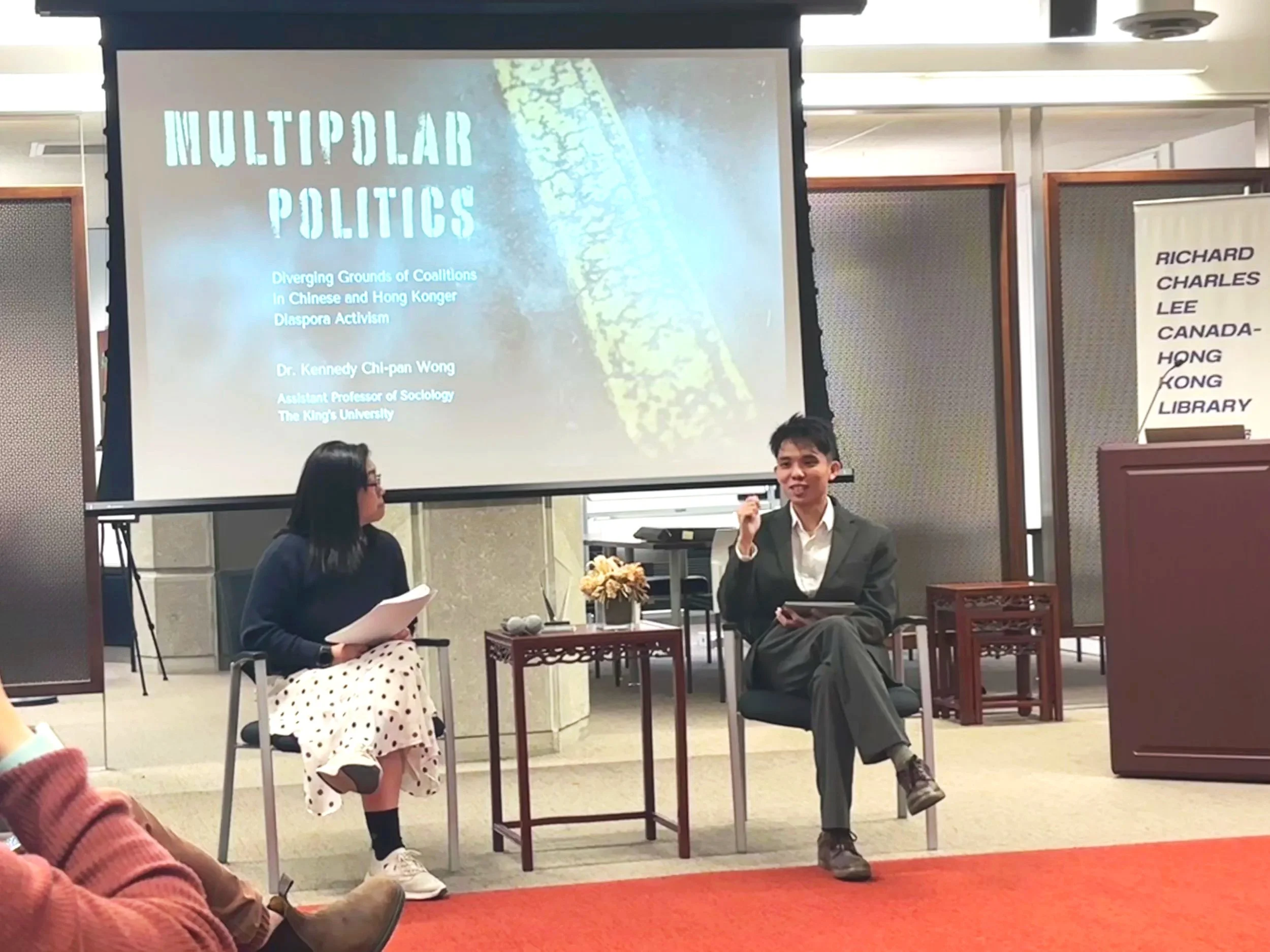
On November 20, 2025, the Professor Kennedy Chi-pan Wong, Assistant Professor of Sociology at The King’s University, gave a talk titled “Multipolar Politics: Diverging Grounds of Coalitions in Chinese and Hong Konger Diaspora Activism” at the Richard Charles Lee Canada-Hong Kong Library. This event was held as part of the Hong Kong Diaspora Seminar Series. Bernice Hoi Chung Cheung, a PhD candidate in ethnomusicology at the Faculty of Music, University of Toronto, whose research also focuses Hong Konger communities, served as the discussant.
In his talk, Wong pointed out that migrant activists are not only diaspora groups living in host societies, but also groups engaging in struggles for democracy in their homelands and working towards transnational democratic change. He focused on activist groups within Hong Konger migrant communities, examining how they identify, recognize, and shift their identities and understandings of ethnicity, diaspora, and immigration while engaging in Left and Right activism in the host country. This research presentation, based on five years of global ethnographic research, including 161 interviews with Hong Konger activists and their coalitions across five countries, is now part of his current book project, Multipolar Politics: Challenges of Global Alliance-Building Against Authoritarianism.
To understand collective actions, movement development, and resource mobilization of Hong Konger migrant activism, Wong drew on Social Movement Studies in this research. He adopted a multipolar perspective to analyze the multipolar dynamics of migrant activist communities and argued that transnational migrant politics is not binary and should be understood in the global context. His research spanned activists and organizations with two different political positions and engagement, including conservative pro-Trump groups and progressive anti-imperialist groups.
Wong pointed out that the Hong Konger migrant activists do not only tie with their host lands Western societies and U.S. politics in particular—but is also deeply connected to the homeland, Hong Kong. Their understandings of democratic solidarity and political practices shaped their engagement with different social issues. For example, pro-Trump Hong Kong democracy activists may hold a strong anti-China stance while tie with Chinese Republicans. Progressive activists may understand “Chinese” within a pan-regime framework and form solidarities with broader pan-Asian communities. Their activism is further connected with other global struggles, such as the #BlackLivesMatter movement in the United States, which in turn reshapes their ethnic identities in different ways.
Wong argued that the multiple identities of Hong Konger migrant activist groups are rooted in different fields of activism, and that these overlapping positions are articulated through multiple, interconnected struggles. Drawing on his fieldwork, particularly in Los Angeles between 2019 and 2022, he illustrated how this dynamic operates in practice and how it informs his framework of multipolarity.
Through coalition cases such as Democracy Now Society and Hong Kong Republicans, Wong demonstrated that immigrant conservatism is not merely driven by activists’ self-interests. It is also shaped by political identities and goals, which in turn push Hong Kong diaspora activism toward policy advocacy, protests, and other forms of mobilization in response to both domestic and international developments.
Wong also discussed about Hong Konger activist engagement with Stop Asian Hate rallies in San Francisco in 2022. While conservative groups may come into conflict with pro-regime Chinese organizers in Chinatown. Progressive Hong Konger diaspora activists, however, actively pursue Asian-focused alliances and engage with other anti-racism movements such as #BlackLivesMatter movement.
As Wong addressed, the complex aspect of migrant activist engagement lies in its diverse and transnational political position in multiple societies. This complexity demonstrates that a simplified Left–Right political polarity is not sufficient for understanding transnational diaspora communities. Instead, migrant political solidarities should be analyzed within transnational and global structural contexts.
In the near future, more of Wong’s work will be explored in his book Multipolar Politics, which examines how migrant activists build political alliances across borders to advance democratic change and navigate the conflicts in activism.