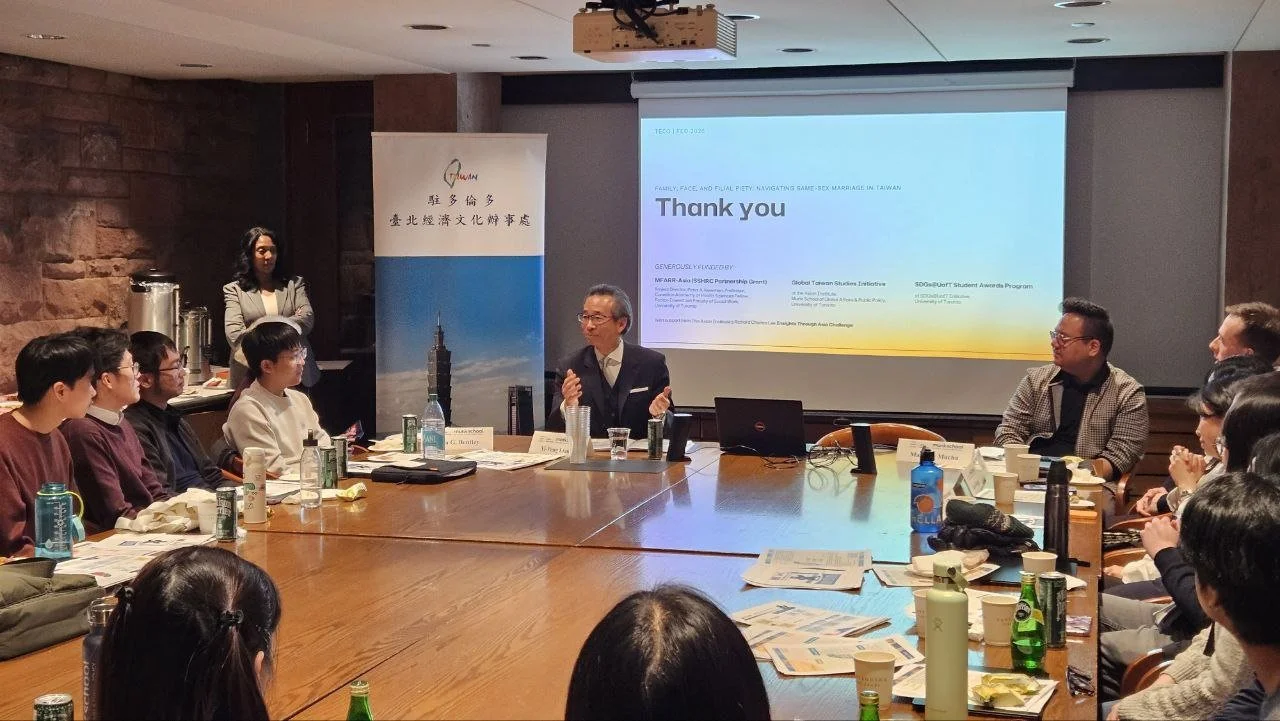
Taipei Economic and Cultural Office (Toronto), Director General, Mr. Yi-Peng Liang in conversation with Munk School students.
Photo courtesy TECO Toronto.
Written by Lorraine Pan
Edited by the Taiwan Gazette
Photo by Lorraine Pan
On February 11, an informative conversation with Mr. Yi-Peng Liang, Director General of the Taipei Economic and Cultural Office in Toronto, was held at the Munk School of Global Affairs & Public Policy. The event, organized by the Global Taiwan Studies Program at the Asian Institute, brought students together to discuss Taiwan and global affairs. It also introduced professional development opportunities for young professionals in Taiwan.
Following welcoming remarks by Julia Bentley, Senior Fellow at the Munk School of Global Affairs & Public Policy, Mr. Yi-Peng Liang, Director General of the Taipei Economic and Cultural Office in Toronto, provided an introduction to Taiwan’s economic and political developments in 2026, and the opportunities available for young people.
Mr. Liang emphasized that Taiwan, like Canada, is a democratic and free society. He described Taiwan as an excellent destination for scholars and professionals seeking to advance their academic and career development, while also strengthening relations with Canada. He further noted that the Taiwanese government provides a wide range of research and career programs and funding for young people.
After Mr. Liang’s talk, an academic research presentation titled “Family, Face, and Filial Piety: Navigating Same-Sex Marriage in Taiwan” was presented as an example of experiential learning in Taiwan. The research was conducted by three master’s students at the University of Toronto – Jordan Chang, Jake Sajko, and Valeria Widjaja.
In their presentation, the researchers introduced Taiwan as the first country in Asia to legalize same-sex marriage in 2019. They also emphasized that “family” is an important dimension in discussions of LGBTQ+ rights within Asian contexts. Therefore, their study focused on the role of family in Taiwan to examine the social impact of marriage equality. Guided by two main questions — “How has the legalization of same-sex marriage in Taiwan impacted familial and cultural acceptance of LGBTIQ+ individuals?” and “What challenges persist in navigating family dynamics and traditional cultural expectations?” — these three researchers used a qualitative research design that included interviews and thematic analysis. They found that in Taiwan, the legalization of same-sex marriage has reshaped identity negotiations and gendered kinship terms within families, and has become an important foundation for envisioning a “good life” for LGBTQ+ people.
The project was also documented as a film, presenting a visual narrative that highlights diversity and inclusion in Taiwan. Conducted at the University of Toronto, this research encourages young scholars and professionals to pursue similar paths of cross-cultural and socially engaged research in Taiwan.
Then, Matthew Mucha, the lead editor of The Taiwan Gazette, introduced the publication and its mission. The Taiwan Gazette is an online magazine supported by the Asian Institute at the Munk School of Global Affairs & Public Policy and is part of the Global Taiwan Studies Program. He explained that it is not only an online magazine, but also a platform that connects Taiwan Studies to the wider world. The magazine publishes academic articles, event reports, and translations of important Taiwanese media outlets such as The Reporter (報導者) and StoryStudio (故事).
As a representative platform for Taiwan Studies in Toronto, The Taiwan Gazette also encourages scholars, students, and professionals to collaborate and submit their work, further strengthening intellectual exchange between Taiwan and the international community.
In the end, Yi-Peng Liang once again thanked everyone for attending the event. He emphasized the global significance of Taiwan Studies and its importance in international dialogue and understanding. He also encouraged participants to continue engaging with Taiwanese cultural initiatives, especially by taking part in the upcoming Lunar New Year celebration event, which would further showcase Taiwanese cultural heritage.