
Written by Lorraine Pan
Edited by the Taiwan Gazette
Photo by Lorraine Pan
The speaker’s bio:
Julia G. Bentley is a former Canadian diplomat whose work focuses on Asia, where she lived for over 20 years. She served as a diplomat in China, Taiwan, India, and Malaysia, where she was High Commissioner. At the Department of Global Affairs Canada in Ottawa, she was successively Director for Northeast Asia, Executive Director for South Asia, and Director General for South Asia. She retired in 2024 and is now affiliated with the Munk School at the University of Toronto, the York Centre for Asian Research, the Asia Pacific Foundation of Canada, and National Taiwan University’s Centre for China Studies. She has degrees in East Asian Studies from Princeton and the University of Toronto, as well as a postgraduate diploma in modern Chinese history from Nanjing University.
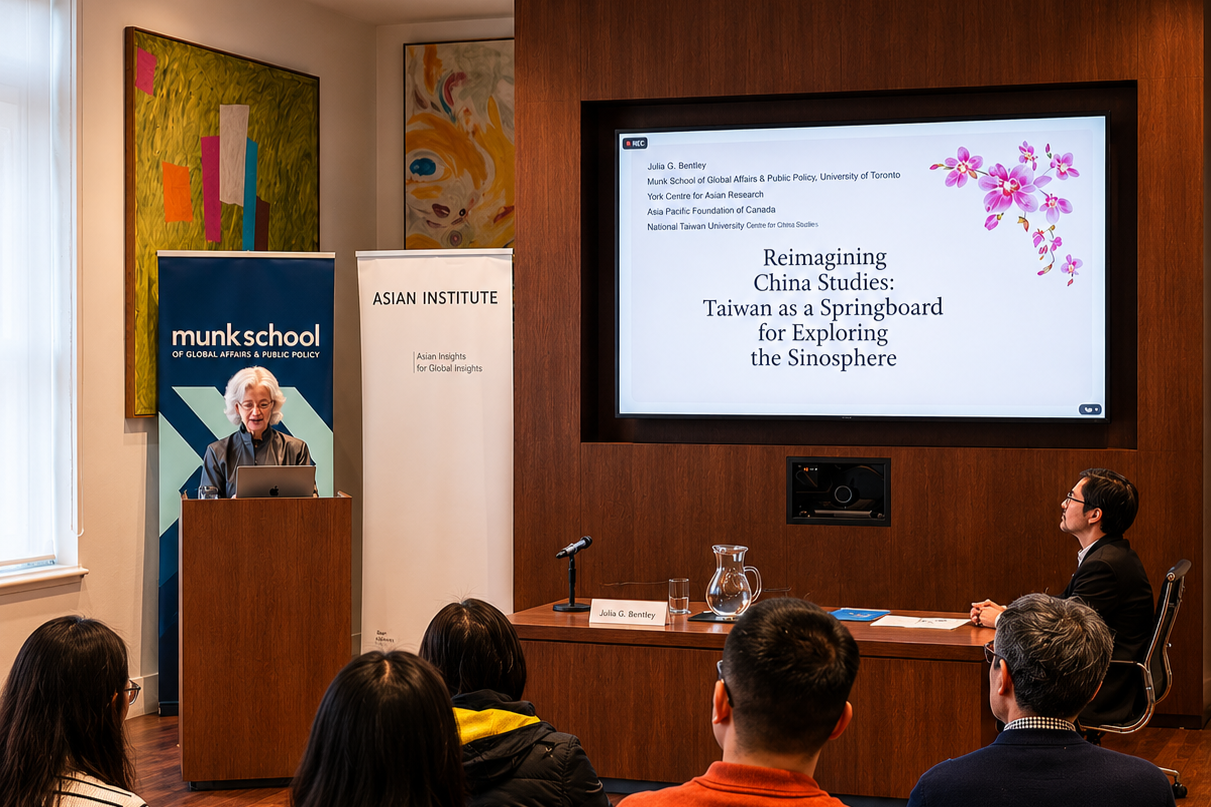
On March 5, 2026, Julia G. Bentley gave a presentation about her research, “Reimagining China Studies: Taiwan as a Platform for Engaging with the Sinosphere,” at the Munk School of Global Affairs & Public Policy. Bentley is a Senior Fellow at the Munk School, an External Research Associate of the York Centre for Asian Research, and a Non-Resident Fellow at National Taiwan University’s Centre for China Studies. She is also a Distinguished Fellow with the Asia Pacific Foundation of Canada. This event is sponsored by the Global Taiwan Studies Initiative, the Asian Institute, and the Cheng Yu Tung East Asian Library.
In the beginning, Prof. Phillip Lipscy gave a short introduction. Prof. Lipscy is Richard Charles Lee Director of the Asian Institute and Director of the Centre for the Study of Global Japan. In this event, he began by introducing Bentley’s academic background and recent research projects.
Then, Bentley started to introduce her research work supported by the Taiwan Fellowship and the China Insights Fund. She situated Taiwan as a key site in contemporary China Studies, emphasizing its role as a democratic and intellectually open environment. She highlighted that Taiwan provides a valuable alternative for international scholars, particularly those concerned about political constraints in the People’s Republic of China. As she cited from a China Studies expert in Taiwan, “Taiwan is as close to China as it is possible to be, without actually being in China, without direct access to Chinese interlocutors.”
Her report, “Reimagining China Studies: Taiwan as a Platform for Engaging with the Sinosphere,” is published by the York Centre for Asian Research. In this report, she outlined that Taiwan plays important roles in China Studies from three aspects: the continued relevance of tapping into Taiwan’s expertise on China; the importance of mastering Mandarin as an entry-level gateway to the Sinosphere; and the role of East Asia research and policy networks.
Therefore, Bentley argued that Taiwan serves as a “springboard” for China Studies due to its cultural affinity with China alongside its more open intellectual environment. She noted that Taiwan offers alternative methodologies for observing and interpreting developments in China, as well as the ability to contextualize People’s Republic of China sources within broader ideological and historical frameworks. Additionally, the availability of English-taught courses in Taiwan broadens access for international students and scholars, creating further opportunities for Canadians to pursue research and training.
Bentley also demonstrated Taiwan’s strengths in research, language instruction, and policy engagement. She highlighted Taiwan’s position within the Sinosphere as a critical vantage point for understanding the evolution of Chinese society and politics, and the importance of familiarity with Taiwan’s current realities and cross-Strait dynamics for developing deeper China competencies.
In closing, Bentley quoted a senior political scientist in Taiwan, stating that “we should not let the spectre of demonisation of China prevent us from understanding what is actually going on in China.” She encouraged scholars and students to engage with Taiwan as a platform for research, emphasizing its importance for future studies of China and the broader Sinosphere.
