
Written by Taiwan Gazette
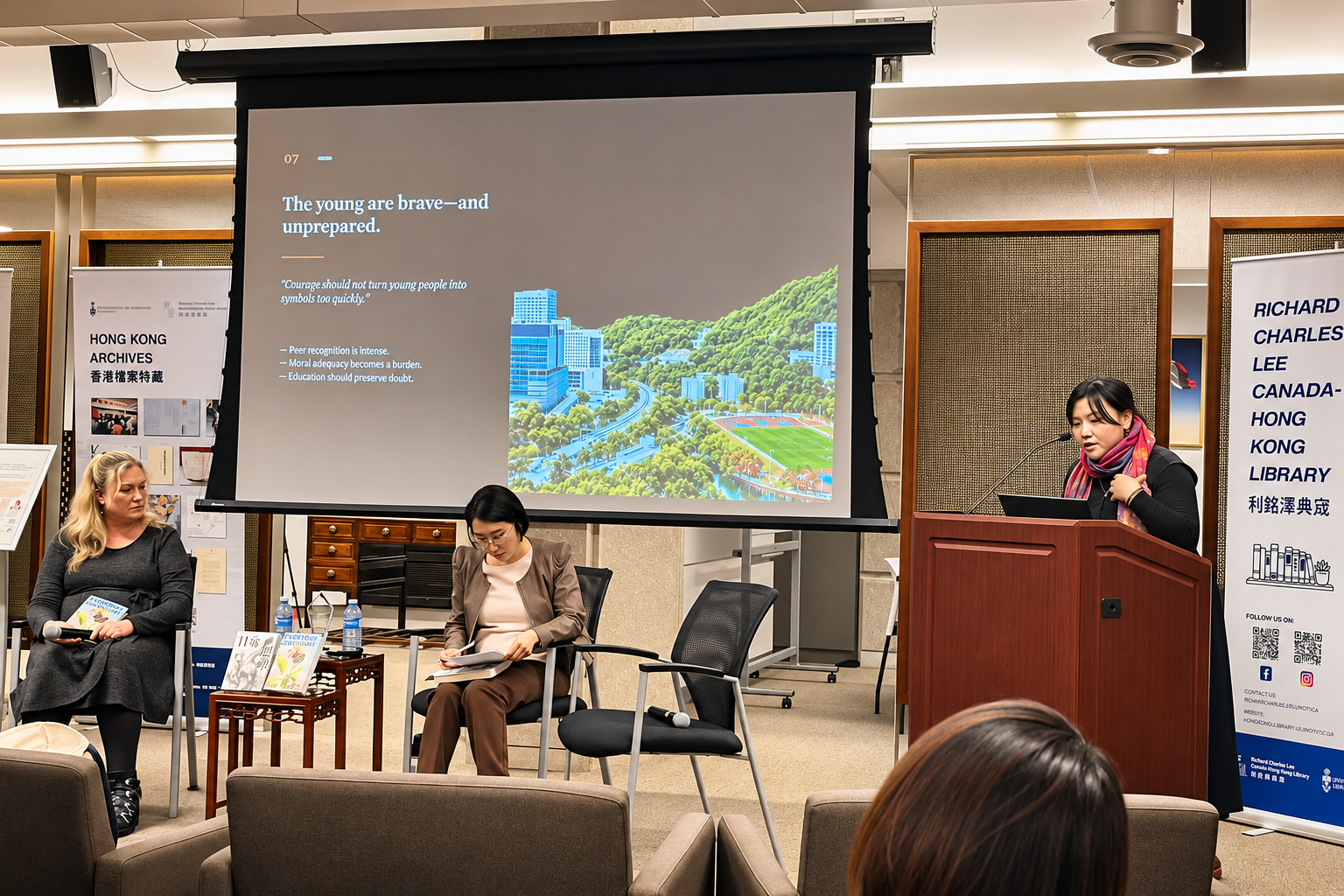
Dr. Jennifer Feeley (left), Dr. Yiwen Liu (centre), and Gigi Leung (right).
What happens to ordinary life when history suddenly takes place? This was one of the central questions raised by Hong Kong writer Gigi Leung during the book talk featuring the new English translation of her novel, Everyday Movement. The book centers the everyday experiences of ordinary citizens in Hong Kong during the 2019 Anti-Extradition Bill Movement. The book was written in Chinese and recently translated into English by Dr. Jennifer Feeley.
Leung kicked off the event by introducing the historical context that inspired her book and the process of writing it. She recalled when the Hong Kong police entered New Town Plaza, a shopping mall in Sha Tin, and confronted protesters on July 14, 2019. Before this incident, it was difficult to imagine the police entering such a commercial space. A popular shopping mall like New Town Plaza is a sanctuary of Hong Kong’s capitalist culture, which made it seem like a forbidden site for police violence. The incident prompted her to reflect on what happens to people’s private lives and personal relationships when major political events suddenly interrupt the ordinary routines of everyday life.
Leung’s writing journey was itself affected by the changing political environment in Hong Kong. This book initially began as a column, which was discontinued following the introduction of the National Security Law. After moving to Taiwan, she encountered a different set of challenges in reaching her intended readers. Despite the shared written language, differences in vocabulary and cultural references between Hong Kong and Taiwan raised questions about how Hong Kong stories could be told to audiences outside their original socio-cultural contexts.
These questions became even more complicated when her work was translated into English. Dr. Jennifer Feeley reflected on the extensive translation and editing process, which took approximately nine months. During this period, the original collection of interconnected short stories was restructured into a novel, and some of the characters and storylines were combined. The process involved not only translating the language but also contextualizing the political and cultural references for English-language readers.
The panelists pointed out the tension between preserving the original writing style and catering to the Anglophone market when translating and editing. For writers and translators, the Anglophone market’s preferences could undermine their creative agency, as the cultural paradigm dominating the North American publishing market largely determines what can be written in and translated into English. Feeley emphasized the different literary conventions that shaped her translation. While the original writing was lyrical and poetic, the English-language publishing market, particularly in North America, tended to favor shorter sentences and more concise prose. The conversation thus raised a broader question about how literary genres and publishing conventions shape which stories become accessible to international audiences, and what might be lost or changed in the process.
The panelists also discussed why we still need fiction when there are other ways to document political events and social movements. For Leung, fiction offers a different way of understanding history. Rather than simply documenting what happened, fiction allows writers and readers to explore the emotions, ambiguities, and interpersonal tensions experienced by individuals living through political events. In particular, Everyday Movement attends to the tensions and differences among people who shared similar political aspirations during the movement. Yet political solidarity does not necessarily erase disagreements or conflicts in everyday relationships. Leung was quick to remind the audience that characters should not simply serve as spokespeople for political or moral positions. Her stories do not offer a convenient villain, nor do they attempt to provide definitive answers to political questions.
During the discussion, Dr. Yiwen Liu asked whether Leung’s fiction could be understood as a counternarrative to the hero-versus-villain framework that often characterizes Western representations of political movements. Leung explained that her intention was not necessarily to challenge a particular grand narrative. Instead, drawing from her observations and experiences as an educator, she hoped to raise questions about the complexities of people’s lives. The ambiguities in her stories were deliberately preserved, allowing readers to arrive at their own interpretations. In the context of a mass social movement, individual experiences and personal relationships can be easily overshadowed by collective political goals. Fiction, as Leung’s work shows, offers a space to explore these individual experiences without reducing them to a single political narrative.
As the event marked the final stop of Leung and Feeley’s North American book tour, Leung also reflected on the question of readership. Many of her Hong Kong friends, she noted, might not wish to revisit memories of the movement, particularly after experiencing its traumatic aftermath and moving on with their lives. Yet this also opened up the possibility of reaching unexpected readers who might find something familiar in stories grounded in a very specific political and historical context.
The event was kindly sponsored by Taipei Economic and Cultural Offices in Toronto and in New York, and organized by the Global Taiwan Studies Program at the Asian Institute of the Munk School of Global Affairs and Public Policy and the Department of Language Studies at the University of Toronto Scarborough. The event took place at the Richard Charles Lee Canada-Hong Kong Library of the University of Toronto Libraries.
Speakers’ Bios:
Gigi Leung is a novelist and poet from Hong Kong who now lives in Taipei. She is the author of The Melancholy of Trees and Everyday Movement, both originally written and published in Chinese. The English edition of Everyday Movement, translated by Jennifer Feeley, was published by Riverhead Books in February 2026. Her work has received major literary honors, including the Golden Tripod Award for Literature and the TSMC Literary Award, and was also a finalist for the Taipei Literary Award.
Dr. Jennifer Feeley is the award-winning translator of Gigi L. Leung’s Everyday Movement; Xi Xi’s Mourning a Breast, Not Written Words: Selected Poetry of Xi Xi, and Carnival of Animals: Xi Xi’s Animal Poems; Tongueless by Lou Yeet-Wa; Chen Jiatong’s White Fox series; and Wong Yi’s Cantonese chamber opera libretto Women Like Us. She is currently working on a new translation of Xi Xi’s My City, along with Gigi L. Leung’s The Melancholy of Trees. The recipient of the 2017 Lucien Stryk Asian Translation Prize and a 2019 National Endowment for the Arts Literature Translation Fellowship, she holds a PhD from Yale University.
Dr. Yiwen Liu (Moderator) is a SSHRC Postdoctoral Fellow at University of Toronto. She is currently writing a book on literary and screen representations of Hong Kong’s resistance culture.
