
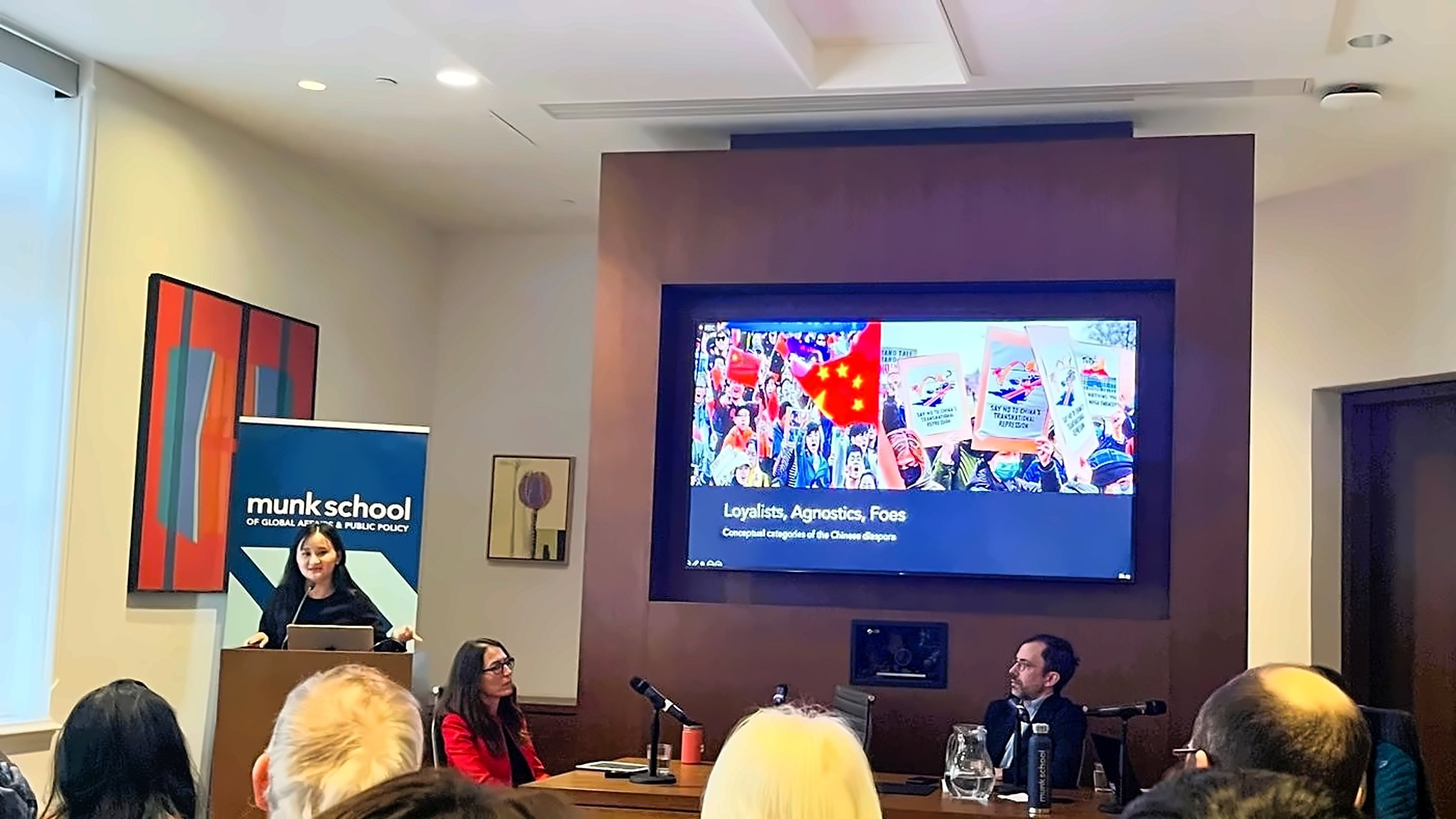
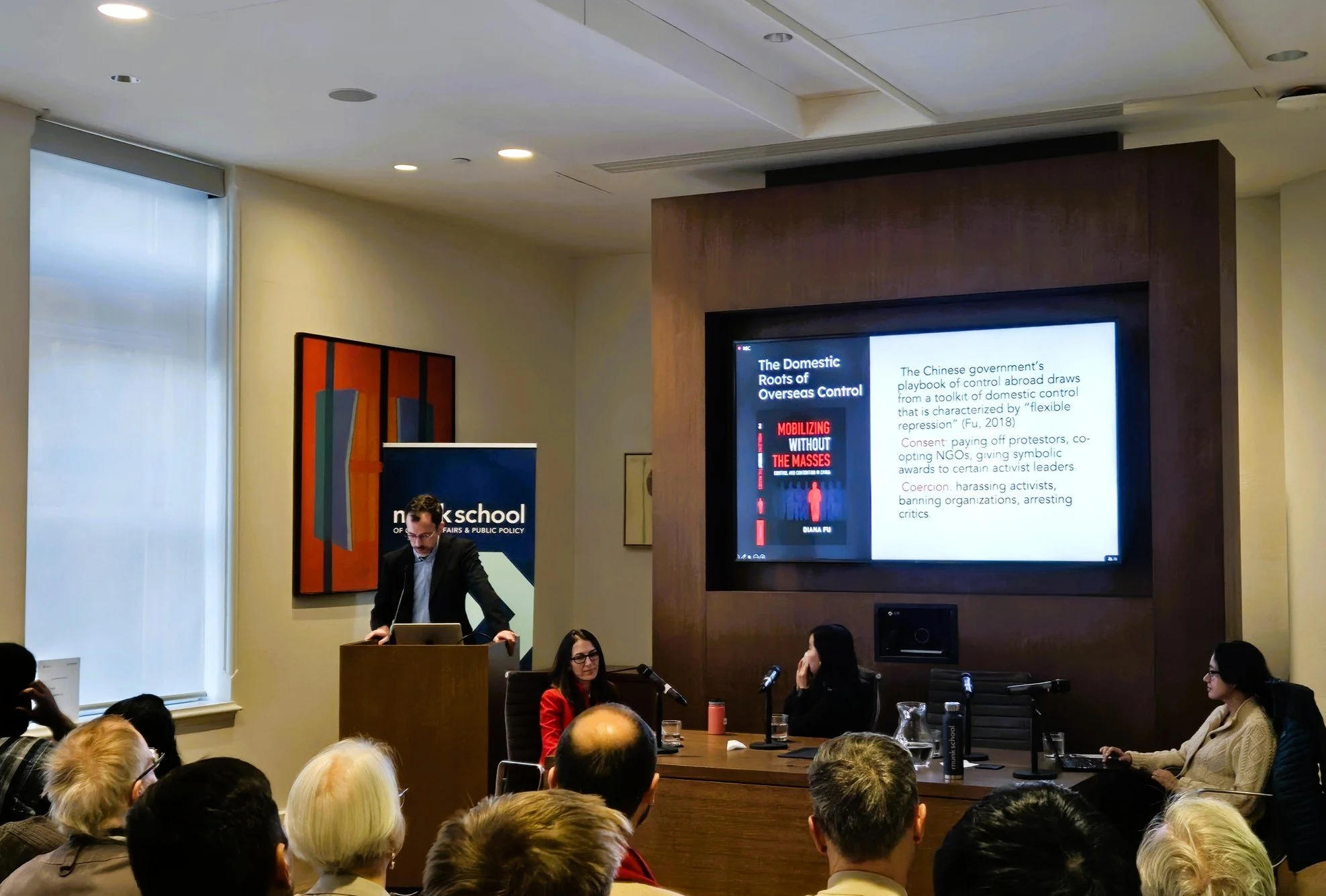
From left to right: Dr. Diana Fu, Dr. Filiz Kahraman, Dr. Emile Driks.
How does the People’s Republic of China (the PRC) govern its 12 million overseas citizens and its even larger diaspora across the globe? On November 20, 2026, Dr. Emile Dirks, Senior Research Associate at the Citizen Lab at the University of Toronto, and Dr. Diana Fu, Associate Professor in the Department of Government at Cornell University, answered this question at the Munk School of Global Affairs & Public Policy in a joint talk on their forthcoming book How Global China Governs its Diaspora: Consent and Coercion.
How Global China Governs its Diaspora argues that Beijing manages its diaspora through consent and coercion, drawing on institutions associated with the Chinese Communist Party. During the talk, the co-authors explained their motivation for writing the book, outlined the PRC government’s tactics of diaspora statecraft, and explored how China’s approach differs from those of other states. They also briefly discussed the policy implications for host countries.
Seeds of the project germinated in 2022, when Canadian media began to report allegations of China’s interference in Canada’s 2019 federal elections. Then, in 2024, when Canada’s Foreign Interference Commission officially confirmed Beijing’s attempts at election interference, the co-authors realized they needed to address the issue through academic research. “We really wanted to make an intellectual contribution to the public discussion by giving people an intellectual framework to understand what was going on beyond the headlines,” Fu said. “We wanted to provide some analytical leverage for understanding where these tactics come from.”
The book is organized around three questions: What characterizes Beijing’s playbook of diaspora statecraft? What are the domestic origins of these tactics? And to what extent is Beijing’s diaspora statecraft distinctive? Fu explained that Beijing effectively categorizes the diaspora into three groups: friends, foes, and agnostics. These categories emerged from Chinese domestic politics as part of the Chinese Communist Party’s united front strategy. The united front, Fu explained, is a “century-old strategy for securing power and expanding its influence by gaining allies among non-party members.” Today, Beijing extends these categories to diaspora statecraft through a flexible distribution of carrots and sticks, or what the authors described as consent-building and coercion. According to Fu, one example of diasporic consent-building is inviting influential members of overseas Chinese communities to participate in party-sponsored conferences. Another is the “borrowed boats” tactic, through which Beijing seeks influence over overseas Chinese-language media outlets to advance pro-Beijing messages and cultivate support among diaspora audiences.
Dirks extended the discussion by focusing on the coercive dimensions of Beijing’s diaspora statecraft. “They seek to intimidate, harass, surveil, and even abduct these individuals in order to put pressure on the party-state’s foes,” Dirks said. Dirks traced the more recent origins of the coercive tactics as an extension of Xi Jinping’s post-2012 intensification of state repression as a mode of addressing the party-state’s internal crises. In states neighbouring China, Beijing has leveraged its friendly relations with illiberal governments to forcibly return individuals targeted by the CCP. In countries that are further away, including democracies whose authorities are unlikely to cooperate with Beijing’s coercive efforts, the Chinese government has drawn on other methods to intimidate identified foes into silence. In addition to labeling individuals as criminal offenders under the national security law, Beijing exerts pressure on China-based family members of overseas critics and treats them as hostages.
Dirks and Fu identified two features that distinguish Beijing’s diaspora statecraft. First, the flexible use of consent and coercion is rooted in what they describe as a “tried and tested” institution of control that the CCP has developed since the Chinese Civil War with the Kuomintang: the united front. Comparing Beijing’s playbook with those of other countries, Fu observed that “they too have institutions that control diaspora, but none of them rival what the united front is.” Second, unlike Russia or Iran, Beijing has generally been reluctant to assassinate its critics. Dirks suggested that one plausible explanation is that “under Xi, China is trying to present itself as a stabilizing force in world affairs.”
The speakers also reflected on the policy implications of their findings. Dirks and Fu emphasized the importance of distinguishing between Beijing’s “foreign interference” and its “foreign influence.” “Democracies can’t ignore the kind of challenge that autocratic states like China pose. But at the same time, those same democracies cannot take everything as malign, coercive, or unlawful,” Dirks cautioned. Policy makers, advocates, and researchers should take care to discern acceptable foreign influence from unacceptable interference.
Dr. Manjari Chatterjee-Miller, the Munk Chair in Global India, and Dr. Filiz Kahraman, Associate Professor in Political Science at the University of Toronto, served as respondents. Both agreed with the co-authors’ argument that Beijing’s diaspora governance toolkit is distinctive. They elaborated on the particularities of the distinctiveness in comparison with India and Turkey. Chatterjee-Miller noted that “…what makes China distinct and how it treats its diaspora distinct from India is the perception of the diaspora.” While China does not allow dual citizenship, India has a system of graded citizenship through the “Overseas Citizenship of India” regime. Thus, for the current Modi government, what matters is not the creation of a national identity. Instead, it is more interested in seeking remittances or investments from overseas Indians.
Comparing China and Turkey, Kahraman pointed to differences in state capacity and institutional structure. “China’s technological capacity to surveil its population, and its huge diaspora population dwarfs any attempts by Turkey,” she said. She also explained that Turkey incorporates its diaspora into its national politics by granting voting rights for citizens abroad and keeping ties with the emigrants. This is a big part of Turkey’s governance of its diaspora population, but is absent from China’s approach to governing its diaspora.
How Global China Governs its Diaspora: Consent and Coercion will be published by Cambridge University Press as part of the Cambridge Elements series.
From left to right: Dr. Emile Dirks, Dr. Filiz Kahraman, Dr. Diana Fu, and Dr. Manjari Chatterjee Miller.
Speakers:
Dr. Diana Fu is associate professor of Chinese politics and director of the Levinson Program in China and Asia-Pacific Studies. She is a non-resident senior fellow at The Brookings Institution and a public intellectual fellow with the National Committee on US-China Relations. Her research examines popular contention, repression, civil society, and authoritarian citizenship in contemporary China. She is the author of “Mobilizing Without the Masses: Control and Contention in China” (Cambridge, 2018), which won best book awards from the American Political Science Association, the American Sociological Association, and the International Studies Association. Before joining Cornell, Dr. Fu was a professor at the University of Toronto’s Munk School of Global Affairs & Public Policy and Political Science.
Dr. Emile Dirks is a senior research associate at the Citizen Lab at the Munk School of Global Affairs & Public Policy, University of Toronto, where he researches contemporary Chinese politics, authoritarian policing practices, and transnational repression. He has written extensively on state surveillance in China and is the co-author of a forthcoming book on how China governs its diaspora.
Panelists:
Dr. Manjari Chatterjee Miller is Professor of international relations, and the inaugural Munk Chair in Global India at the Munk School. She is a Senior Fellow at the Council of Foreign Relations. She is also an associate at the Asia Center, Harvard University. An expert on India, China, and rising powers, she is the author of Why Nations Rise: Narratives and the Path to Great Power (2021, shortlisted for the 2022 Hedley Bull Prize in International Relations), Wronged by Empire: Post-Imperial Ideology and Foreign Policy in India and China (2013), and the co-editor of the Routledge Handbook of China-India Relations (2020).
Dr. Filiz Kahraman’s research investigates law and politics from international and comparative perspectives. Her book, Labor In Hard Times: Workers’ Legal Mobilization at the European Court of Human Rights (Cambridge University Press, 2026), examines why labor activists in Europe pursued human rights law as a mobilization strategy and how international law shaped workers’ struggles on the ground.
Written by Richard Wu
Edited by the Taiwan Gazette